Pages

Showing posts with label Home Experiments. Show all posts

Saturday, 16 June 2012

What is Your Lung Volume?

                                                     Test Your Lung Volume
Do you think you're fit and healthy? Let's test your lung volume to find out. Just how much air can your lungs can hold? With the help of a few simple household objects, some scientific know how and a dash of curiosity you can make this experiment look easy.


What you'll need:
  • Clean plastic tubing
  • A large plastic bottle
  • Water
  • Kitchen sink or large water basin

Taste Testing Without Smell

                                                      How do things taste without your sense of smell?
We all know that some foods taste better than others but what gives us the ability to experience all these unique flavours? This simple experiment shows that there's a lot more to taste than you might have first thought.


What you'll need:
  • A small piece of peeled potato
  • A small piece of peeled apple (same shape as the potato so you can't tell the difference)

Make Your Own Quick Sand

                                               Make Quick Sand


Quick sand is a fascinating substance, make some of your own and experiment on a safe scale. Amaze your friends by demonstrating how it works.

What you'll need:
  • 1 cup of maize cornflour
  • Half a cup of water
  • A large plastic container
  • A spoon

Design and Test a Parachute

                                                               Make a parachute
Learn about air resistance while making an awesome parachute! Design one that can fall slowly to the ground before putting it to the test, making modifications as you go.


What you'll need:
  • A plastic bag or light material
  • Scissors
  • String
  • A small object to act as the weight, a little action figure would be perfect

Sunday, 10 June 2012

Invisible Ink with Lemon Juice

Making invisible ink is a lot of fun, you can pretend you are a secret agent as you keep all your secret codes and messages hidden from others. All you need is some basic household objects and the hidden power of lemon juice.

What you'll need:
  • Half a lemon
  • Water
  • Spoon
  • Bowl
  • Cotton bud
  • White paper
  • Lamp or other light bulb 

Will the Ice Melt and Overflow?

At first thought you might think that an ice cube sitting at the very top of a glass would eventually melt and spill over the sides but is this what really happens? Experiment and find out!

What you'll need:
  • A clear glass
  • Warm water
  • An ice cube

Test Your Dominant Side

Check out this cool experiment that will teach you more about how your body and brain work together. Test your dominant side by completing a series of challenges. Which hand do you write with? Which foot do you kick with? Do you have a dominant eye? Do you throw with one side of your body but kick with the other? Are you ambidextrous? Answer these questions and much more with this fun science experiment for kids. 

What you'll need:
  • A pen or pencil
  • Paper or a notepad to write your findings on
  • An empty tube (an old paper towel tube is good)
  • A cup of water
  • A small ball (or something soft you can throw) 

Friday, 8 June 2012

Baking Soda & Vinegar Volcano

                                                    Make a vinegar volcano with baking soda & vinegar

Use baking soda and vinegar to create an awesome chemical reaction! Watch as it rapidly fizzes over the container and make sure you've got some towels ready to clean up.


What you'll need:
  • Baking Soda (make sure it's not baking powder)
  • Vinegar
  • A container to hold everything and avoid a big mess!
  • Paper towels or a cloth (just in case) 

Blowing Up Balloons With CO2

                                                Blowing up balloons with lemon juice, baking soda & carbon dioxide
Chemical reactions make for some great experiments. Make use of the carbon dioxide given off by a baking soda and lemon juice reaction by funnelling the gas through a soft drink bottle. Blowing up balloons was never so easy!


What you'll need:
  • Balloon
  • About 40 ml of water (a cup is about 250 ml so you don't need much)
  • Soft drink bottle
  • Drinking straw
  • Juice from a lemon
  • 1 teaspoon of baking soda 

Diet Coke & Mentos Eruption

                            Diet Coke & Mentos Geyser Eruption
One of the most popular experiments of modern times is the Diet Coke and Mentos Geyser. Made popular by Steve Spangler, this experiment is a lot of fun and sure to amaze your friends and family (assuming you do it outside rather than in the living room).


What you'll need:
  • Large bottle of Diet Coke
  • About half a pack of Mentos
  • Geyser tube (optional but makes things much easier)

Make Lemonade Fizzy Drink

                                                                        Make your own lemonade fizzy soda softdrink

There's a lot of people out there that like drinking fizzy drinks, so why not do a fun science experiment that leaves you with your own lemon soda to drink afterwards!

A bit of lemon here and a bit of baking soda there and before you know it you'll be an expert at making your own fizzy drinks. Make your own lemonade softdrink with this fun experiment for kids.

What you'll need:
  • Lemon
  • Drinking glass
  • Water
  • 1 teaspoon of baking soda
  • Some sugar to make it sweet

Make a Big Dry Ice Bubble

                                                                      Make a dry ice bubble
Have fun making a dry ice bubble that will grow and grow as it fills with fog. This experiment is a great one for adults to do with kids. Add water to the dry ice, cover it with a layer of soapy water and watch your bubble grow, how big will it get before it bursts? Give it a try and find out!


What you'll need:
  • Water
  • A large bowl with a lip around the top (a smaller bowl or cup will work too)
  • A strip of material or cloth
  • Soapy mixture for making bubbles (water and some dishwashing liquid should do the trick)
  • Dry ice - one piece for a cup, more for a bowl. Places where adults can buy dry ice include large grocery stores and Walmart. Butchers and ice cream stores might have some too.

Sunday, 13 May 2012

Needle Through A Ballon

Have you ever seen someone pop a balloon with a needle? Is it possible to stick a needle through a balloon without popping it?

You will need the following materials:

• balloons
• long wooden or metal skewers
• petroleum jelly
• a sharp pin
• cellophane tape

The Fire Proof Balloon

Balloons are rather fragile things. You know that they must be kept away from sharp objects. The also need to be kept away from flames. A fire can weaken the rubber and cause it to burst. However, in this experiment you will find out how you can hold a balloon directly in a flame without breaking the balloon.

For this experiment you will need:
  • two round balloons, not inflated
  • several matches
  • water

Making Things Glow In Dark

Have you ever wondered what makes certain things glow under black lights?
For this experiment you will need:

• a black light
• petroleum jelly
• a piece of paper

Experiment with Bernoulli`s Principle

Have you ever said of someone who was talking too much, “He’s just an old windbag”? Actually, windbags can be fun (think balloons), and they allow us to learn about an important property of moving air called Bernoulli's Principle.

Bouncing Balloon
For this experiment you will need:
• an electric hair dryer with circular nozzle
• a balloon
• a table tennis ball
First, blow up the balloon and tie off the end. Hold the balloon out at arm’s length and let go of it. Does it stay there, or drop?

Build An Electric Motor

How does a motor change electrical energy into motion? An electric current produces a magnetic field. This magnetic field can be attracted to or repelled by a permanent magnet. This attraction or repulsion can cause movement in a wire that carries an electric current.

You will need the following materials:

         1 meter (3 feet) of 22-gauge or 24-gauge solid-core insulated wire
                  e.g. Radio Shack catalog # 278-1215
         2 disk magnets
                  e.g. Radio Shack Catalog # 64-1888
         2 insulated test cables with a clip on each end
                  e.g. Radio Shack catalog # 278-1157
                  (2 pieces of above insulated wire can also be used)
         a plastic cup
         two large rubber bands
         two jumbo size (2-inch) paper clips
         D-cell battery
         wire strippers
         waterproof marking pen
         optional holder for D-cell
                  e.g. Radio Shack catalog # 270-403

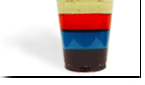
Layerd Liquids Experiment

Have you ever heard the phrase "oil and water don’t mix"? First we will test that expression, then look at interesting combinations of several other liquids.

Oil and Water
You will need the following materials:
• ¼ cup (60 ml) water
• ¼ cup (60 ml) vegetable oil
• a small glass
• food coloring
First pour the water into the glass. Add a couple of drops of food coloring and mix. Next add the oil. What do you see? Which layer is on top?

Dancing Raisins Experiment

Carbon dioxide gas dissolved in soft drinks gives them their fizz. You can use the carbon dioxide fizz from a soft drink to make raisins dance.
For this experiment you will need:
  • a can of colorless soda (e.g., 7-Up or Sprite)
  • a tall, clear glass or plastic cup
  • several raisins (fresh raisins work the best)

Chemiluminescene - Cool Light

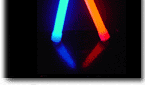
Many chemical reactions produce both light and heat. A burning candle is such a reaction. When a candle is lit, its flame both glows and becomes hot. It is much less common for a chemical reaction to produce light without heat. The light from such reactions is called cool light, because it is created without heat. Reactions that produce light without heat are called chemiluminescent reactions. Perhaps the most familiar chemiluminescent reactions are those that occur in living organisms. Fireflies produce light without heat by a chemiluminescent reaction. Chemiluminescent reactions that occur in living organisms are called bioluminescent reactions.